For the uninitiated, this is not just a platform tax; it is a fundamental redesign of market incentives. Under the new rules, 20% of all collected fees are redistributed back to market makers in the form of daily USDC rebates. By taxing “takers” (those who remove liquidity) and rewarding “makers” (those who provide it), Polymarket is effectively attempting to kill latency arbitrage while subsidizing the professional liquidity providers who keep spreads tight.
The Mathematics of the Taker Fee
The fee isn’t a flat rate. Instead, it follows a dynamic curve that peaks when a market is at its most uncertain point—50/50 odds. At this “peak” of 50 cents, the effective fee rate hits 1.56%. As the market moves toward high-conviction extremes (approaching 0% or 100%), the fee tapers off to near-zero.
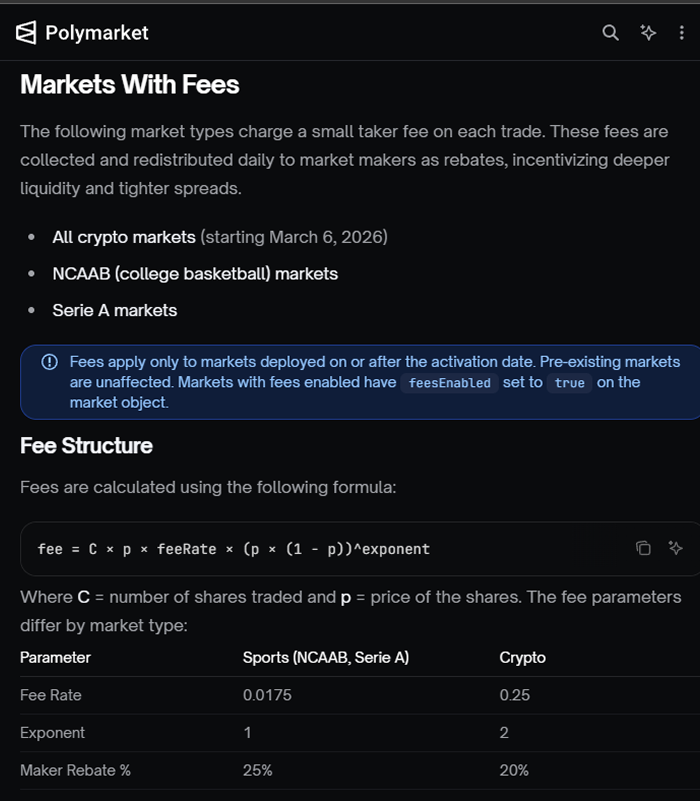
This specific “bell curve” design is intentional. It targets automated bots that profit from tiny infrastructure lags between Polymarket and spot exchanges. By making the cost of “taking” higher than the arbitrage margin at 50/50 odds, Polymarket is prioritizing market quality over raw, bot-driven volume.
What This Means for LPs
For liquidity providers, the math is increasingly attractive. Because rebates are calculated per market, makers only compete with others within that specific timeframe. With the infrastructure now live across all crypto timeframes, the pool of USDC up for grabs has grown significantly.
However, early data suggests participation in these new tiers remains thin. Professional traders note that those who haven’t yet adjusted their automated strategies are “leaving money on the table,” as the redistribution mechanism essentially creates a yield-bearing environment for stable liquidity.
While the majority of Polymarket’s event and political markets remain fee-free, today’s expansion marks a clear pivot toward institutional-grade market microstructure. For the retail trader, it means more reliable fills; for the professional maker, it’s a siren call to deploy more capital.
Join for more update and get real-time alerts here: t.me/DailyKoinUpdate
You May Also Read:
- ego price
- SASUF-NRF Seed Grants 2026: Eligibility, Funding, Deadlines and Full Application Guide
- How to Install Claude Code on Ubuntu Linux 2026:The Ultimate Setup Guide for High Velocity AI Engineering
- How I Turned Claude and Obsidian into a Self-Running Business Brain (And You Can Too)
- Best GitHub repos for Claude code that will 10x your next project







1 thought on “Polymarket Expands Fee Structure to All Crypto Markets: A Major Shift for Liquidity Providers”